
Golden Dome's key questions to determine its success
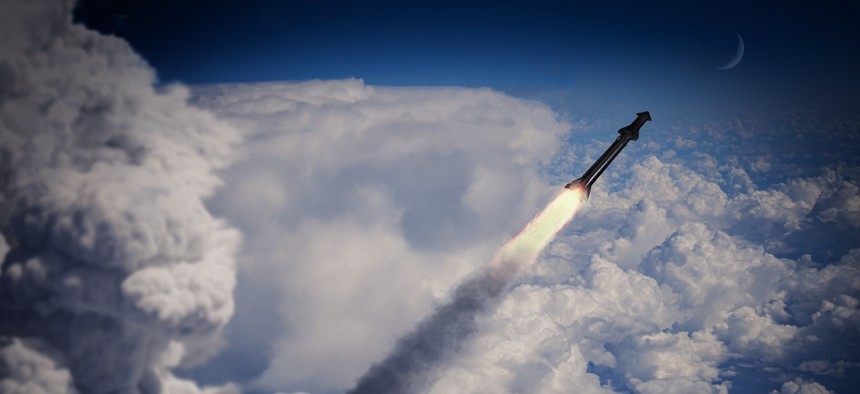
Gettyimages.com / Ikdam

 By
Ross Wilkers
By
Ross Wilkers
John Plumb, a former assistant defense secretary for space policy, laid out some of those factors at a WT Power Breakfast and affordability is one of them for this missile defense system.
Layers upon layers is one way to describe Golden Dome, the U.S. military’s ambitious vision for building a missile defense system for protecting the U.S. before adversarial weapons launch or during their flight.
But at its essence, Golden Dome is the next iteration of how the U.S. uses a variety of technologies on the ground and in space as missile threats evolve.
How the Pentagon prioritizes its spending plans will determine whether Golden Dome lives up to the billing or not, in light of the Congressional Budget Office’s new estimate that the system will cost $1.2 trillion. Space Force Gen. Michael Guetlein, who leads the program, told House lawmakers in April that space-based interceptors may end up being too expensive.
Space-based interceptors do garner much of the attention, but software and sensors will move data between operators responsible for making Golden Dome work. President Trump wants the system operational by 2029.
In light of the cost projections and aggressive timeline, what will determine whether Golden Dome is a success or not?
John Plumb, a former assistant defense secretary for space policy, told a WT Power Breakfast audience on Friday that the idea of space-based interceptors hitting a target in space is a “narrow definition of what success is here.”
Congress could cut that element out of Golden Dome in the future, but Plumb pointed out that there are many more elements to the system.
“It’s just like anything else in defense. You don't say, ‘OK, now I have missile defense and it's a success and I'm good,’” said Plumb, now head of strategy at K2 Space. “You're constantly making it better you're constantly iterating the threat evolves.
“What I think makes it a success is, does it increase my deterrence? Does it decrease the possibility of conflict? That is, to me, the number one success,” Plumb added at the event in Reston, Virginia.
Factor number two points to the money going into Golden Dome and affordability of everything, Plumb said. CBO’s forecast suggests that there may be some future conversations between executive and legislative branch leaders on that front.
“But I think just getting the sensor layers right and getting the data routing right would be a massive success and be really useful for the joint force in any front, not just on homeland defense, not just in the Indo-Pacific, but globally,” Plumb said.
Plumb believes the routing of data is going to move forward no matter what, given how modern warfare is so dependent on the freedom of data movement between miliary operators.
Ground-based radars will be a significant portion there, inclusive of how sensors get meshed together to help identify the best shooter to mitigate the missile threat.
“Then if you want to get really interested, then the question is, can you also do battle damage assessment with your sensor network to say ‘I got those three, I missed that one, I need to shoot at it again,’” Plumb said. “That is continuing to combine the sensors from the ground and from space with the interceptors.”