
How ICF views its return to federal growth
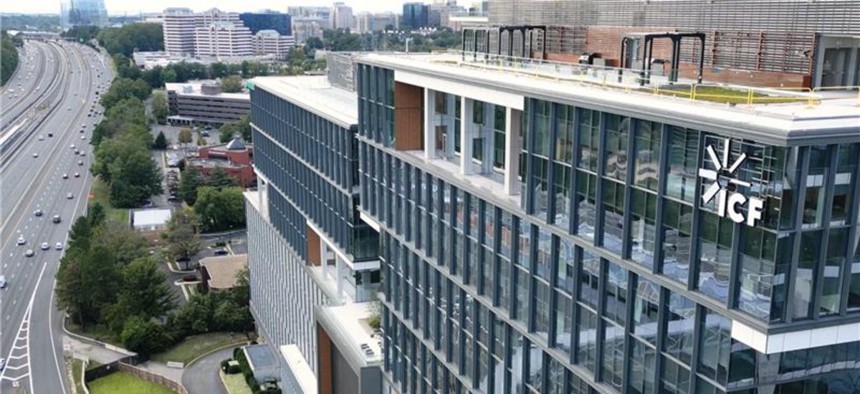
ICF's corporate headquarters in Reston, Virginia. ICF photo.

 By
Ross Wilkers
By
Ross Wilkers
In talking with Wall Street, CEO John Wasson also explains how commercial energy has been a bright spot for the company.
ICF was far from the only publicly-traded contractor that had to navigate a bumpy ride in 2025 that involved Department of Government Efficiency-driven spending reductions and the six-week government shutdown in the fall.
Neither is ICF the only GovCon firm that has to detail what all of that means for investors to consider, but it does provide a snapshot of the federal landscape and an example of how companies have to adjust to changes.
During ICF’s fourth quarter and year-end earnings call with investors Thursday, chief executive John Wasson said the company is looking at a return to growth for its federal business in two buckets.
“We expect IT modernization to return to growth with the improved procurement environment for 2026, and we expect the entire federal business to return to growth in 2027,” Wasson said.
Wasson characterized the federal business as a roughly 50-50 split between its IT modernization portfolio and broader programmatic work.
On the IT front, Wasson said the procurement environment is looking better and opportunities are starting to move even if “it’s not back to where we’d like it.”
For the programmatic side, Wasson acknowledged that “new opportunities there haven’t been as robust as on the IT modernization side” even as the procurement environment there is starting to pick up.
Agencies are unlocking funds on existing contracts and ICF has been “quite successful in winning our recompetes,” Wasson added.
Scrutiny on federal spending will likely continue in 2026 as DOGE activities are now taking place at the department- and agency-level, but a more stable backdrop is leading ICF to see a two-phased trajectory for its federal business.
On the nonfederal side of ICF, commercial energy is the main growth driver amid the company’s push to bring its advisory and technology-enabled services into that sector.
Utilities are seeking to fulfill increased demand for energy as data center construction ramps up across the country, while nuclear reactor developers are positioning for opportunities to supply power for the higher loads.
Wasson characterized the bulk of ICF’s energy sector portfolio as spanning energy efficiency, flexibility management, electric storage and battery storage.
But in more recent years, ICF has been investing more in engineering work as seen by its acquisition of CMY in 2023 and purchase of Applied Energy Group in 2025.
“While that's a smaller part of our business, I think that as we continue to invest the potential for quite significant growth, that's an area where we're looking to deploy our balance sheet in addition to organic growth,” Wasson said of the engineering work.
ICF’s federal business recorded $855 million in revenue during 2025, a 25% decline in sales from those of 2024, owing to the impacts of contract spending cuts and the Oct. 1-Nov. 12 government shutdown. Federal represented 43% of ICF’s revenue profile for 2025, down from the 54% figure for 2024.
Nonfederal revenue climbed 14% year-over-year, primarily on growth in the commercial energy business.
Company-wide fourth quarter revenue of $443.7 million was down 10%, while profit of $46 million showed an 18% year-over-year increase in adjusted EBITDA (earnings before interest, taxes, depreciation and amortization).
Full-year 2025 sales of $1.9 billion were down 5% from the previous year, while adjusted EBITDA of $207.2 million showed a 6% year-over-year decrease on the bottom line. That translates to a 11.1% adjusted EBITDA margin for 2025 versus the 11.2% figure for 2024.
ICF’s initial outlook for 2026 has a revenue range of $1.89 billion-to-$1.96 billion.