
11 companies move to second stage of DARPA’s Quantum Benchmarking Initiative
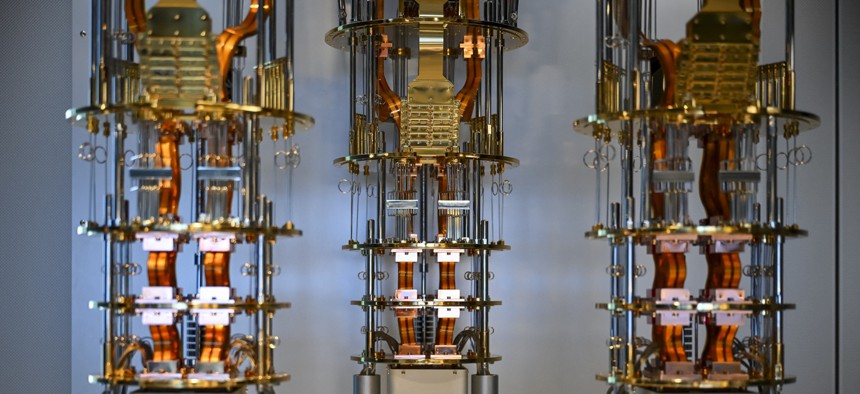
The IBM Quantum System Two is seen at IBM Thomas J. Watson Research Center on June 6, 2025 in Yorktown Heights, New York. ANGELA WEISS/AFP via Getty Images


The selected companies will undergo evaluation to determine if their concepts for a viable quantum computer can be constructed and work as intended.
The Defense Advanced Research Projects Agency has selected multiple technology companies working to innovate in the quantum computing industry to advance to the second stage of its Quantum Benchmarking Initiative to further verify the efficacy of these companies' quantum technologies.
DARPA’s Quantum Benchmarking Initiative, launched earlier this year, is a government program supporting and evaluating quantum industry leaders' efforts to bring a fault-tolerant quantum computer to life and offers objective milestones each participating company must reach within the program.
Stage A of the program — which required participants to describe a quantum computer concept with “a plausible path to realization in the near term,” per the DARPA website — included 15 companies. Stage B of the program — where government teams “will determine if their utility-scale quantum computer concept can be constructed as designed and operated as intended” — will feature 11 companies: Atom Computing; Diraq; IBM; IonQ; Nord Quantique; Photonic Inc.; Quantinuum; Quantum Motion; QuEra Computing; Silicon Quantum Computing; and Xanadu. DARPA confirmed the list of second stage firms on Thursday.
Joe Altpeter, the program manager of DARPA's Defense Sciences Office, said that the advancing companies will continue to be subject to rigorous analyses of their quantum computing systems.
“During Stage B we'll thoroughly review all aspects of their R&D plans to see if they can go the distance — not just meet next year's milestones — and stand the test of trying to build a transformative technology on this kind of a timeline,” Altepeter said in a press release.
Stage C will follow Stage B, which Altpeter said will consist of conducting a real-time test and evaluation of the hardware technology participating companies use in their quantum computers.
“We’ll do all these evaluations without slowing the companies down,” he said.
“IBM has publicly laid out our comprehensive plan and roadmap to scale quantum computers towards fault-tolerance,” Jay Gambetta, director of IBM Research, said in a Thursday press release. “As the industry advances, we look forward to working with DARPA as they continue an unbiased review of potential viable strategies across the field.”