
SpaceX's S-1 lays out its government work and market ambitions
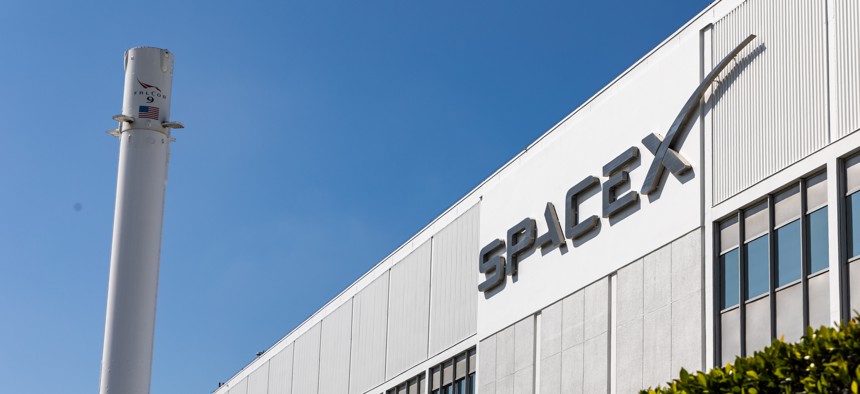
SpaceX's corporate headquarters in Hawthorne, California. Sven Piper / iStock Editorial via Getty Images

 By
Ross Wilkers
By
Ross Wilkers
How much of the revenue for Elon Musk's company comes from the U.S. government? We have an answer to that question, among other details SpaceX now has to disclose.
SpaceX released to the world its long-awaited “S-1” prospectus statement on Wednesday, a step required of all companies before they undertake an initial public offering.
This disclosure is the very first time everyone can take a detailed look at the financial and operational profile of the company Elon Musk started in 2002. SpaceX started out as a pure-play launch company that has since branched out to satellites and artificial intelligence since its inception.
The S-1 pegs SpaceX’s revenue for 2025 at roughly $18.7 billion with this key fact included: one-fifth of sales represents work for U.S. government agencies.
It is important to note that the $18.7 billion figure includes historical results from Musk’s xAI and X (formerly Twitter) businesses, which were folded into SpaceX in February. XAI acquired X in March 2025, but all three businesses, of course, share the common owner and controller in Musk.
The S-1 includes three full years worth of financial results from 2023 to 2025, so it is likely that the aforementioned one-fifth figure would be higher absent those business combinations.
SpaceX is also not shy in talking about what it has become in the past two decades. This line in the S-1 is clear: “We are the primary launch provider for the U.S. government.”
In 2025, SpaceX launched 11 out of 12 medium- and heavy-lift missions for the National Security Space Launch Program that is managed by Space Force and the Reconnaissance Office.
Also in 2025, SpaceX launched all five U.S. cargo and crew missions to the International Space Station for NASA.
The S-1 also describes SpaceX’s U.S. government portfolio as including support to the Federal Emergency Management Agency in coordinating disaster recovery after hurricanes and wildfires, plus the National Oceanic and Atmospheric Administration for at-sea testing and environmental monitoring.
Starshield is another avenue that SpaceX sees as a path to growing its U.S. government market share. These low-Earth orbit satellites are adapted from the company’s Starlink communications network to provide more specific military capabilities such as target tracking, optical and radio reconnaissance, and early missile warning.
“We have leveraged our commercial LEO satellite constellation engineering learnings and operational experiences to develop a secure, dedicated satellite network designed specifically for United States Government customers and national security applications,” the S-1 says.