
The federal market is entering a new operating model

Gettyimages.com/Teera Konakan

 By
Tim Hartman
By
Tim Hartman
Artificial intelligence, commercial-first buying and demands for proof of returns on investment are rewriting the rules for contractors, writes GovExec CEO Tim Hartman.
The old assumptions are no longer relevant.
For a long time, contractors could count on a market dictated by conventional buying patterns, stable points of entry, and longer runways for proving value. A new era has arrived, one where industry and government must collaborate to build a new operating model across government.
And two trends are driving the pace of change: artificial intelligence and the new comfort with commercial technologies in the heart of government infrastructure.
Already, we are seeing the impact: AI is changing how agencies choose, use, and rely on contractors.
Many of the underlying forces remain the same. Agencies still need modernization. They still need digital infrastructure. They still need access to relevant, timely data, and the ability to convert it into action at mission speed.
However, now they are judging those investments more critically. Leaders want to see their return on investment: what improves productivity, what saves money, what reduces risk, and what helps teams deliver faster. And they increasingly want emerging technologies to drive the solution.
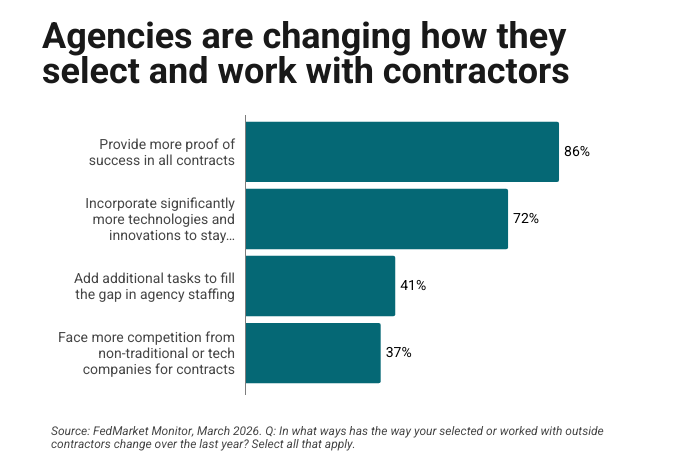
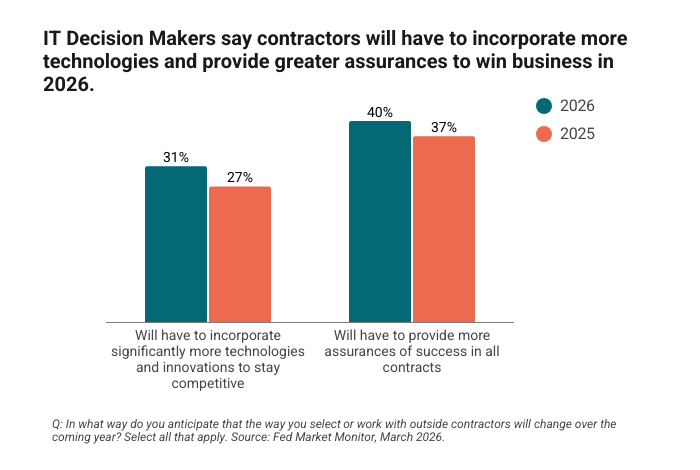
In GovExec Intelligence’s March Fed Market Monitor, 72% of Federal IT decision makers said contractors will need to incorporate significantly more technologies and innovations to stay competitive.
At the same time, they are raising their expectations: 86% of IT decision-makers said contractors will need to provide more proof of success in all contracts.
All of this is driven by the opportunity provided by AI.
A year ago, much of the market was captivated by the promise of the technology, rather than its implementation. Now, AI is the most important driver of the streamlining and automation of internal agency processes.
Contractors must be prepared to answer specific questions as they look down the road: Where can AI improve delivery of citizen services? Where can it support the warfighter? Where can it help increase productivity with a leaner workforce? Where can it be deployed without creating a larger compliance or security problem?
The immediacy of the opportunity is clear when you look at the recent initiatives this administration has prioritized.
GSA launched a “million hours challenge” for its internal AI tool after the agency lost nearly 40% of its workforce. At VA, officials told lawmakers that AI-assisted claims support helped cut average processing time by 42%, from 141 days to 81 days. Across the public sector, agencies reported 3,611 AI use cases in 2025, up 105% from the year before. The work is still getting done, but differently, with more automation than before.
At the same time, acquisition policy is pushing agencies to prioritize commercial technology above bespoke development projects. These initiatives completely upend the traditional go-to-market model for government contractors.
Agencies and decision-makers are much more comfortable adopting commercial software, creating a new era for how agencies develop and manage technology.
For example, OMB’s April 2026 commercial-buying memo says that more than two-thirds of fiscal 2024 federal contract spending was for non-commercial products and services, including more than $130 billion in non-commercial common services such as IT, telecom, professional support, and facilities operations.
Now, agencies have been told to report covered non-commercial awards and justify why commercial solutions don’t work for any awards over $10 million.
Under the hood, the machinery of buying is also advancing. GSA’s Office of Centralized Acquisition Services says agencies can use its centralized model to expand contracting capacity during periods of limited staffing, while piloting AI and automation to accelerate procurement.
The Federal Acquisition Regulation overhaul is built around the same idea. OMB says the rewrite will use plain-language deviation text, streamline the regulation back to its statutory base, and strip most non-statutory requirements out of Part 12 in order to lower transaction costs, increase competition, and make it easier for buyers to negotiate better deals.
Yes, a recognizable name still matters. Scale still matters. Past performance still matters. But they no longer carry the same weight on their own, especially without clear metrics that prove return on investment.
Those three trends — the proliferation of AI, the growing need to specifically demonstrate impact, and the commercial-first mentality — will define this era of procurement. Government is relying more heavily on commercial partners to close capacity gaps, accelerate modernization, and keep delivery moving.
The companies that succeed will be the ones that make it easier for the government to move with speed and confidence, using off-the-shelf technology that can prove its own worth.