
Contractor alleges Army inappropriately used AI to make $450M contract award
Joe Bullinger/U.S. Navy


An industry lawyer anticipates more bid protests will likely allege that agencies misused AI in the procurement process but that could be hard to prove if agencies don’t report their use of AI as “high-impact.”
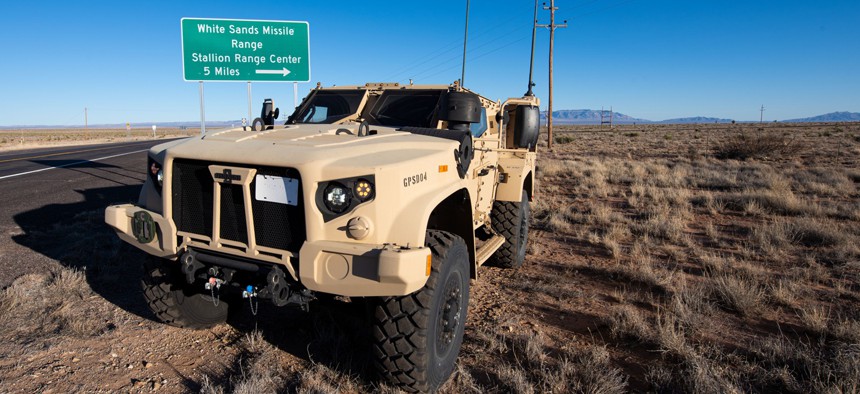
Trax International Corporation is asking the U.S. Court of Federal Claims to direct the Army to reevaluate bids for mission support services at White Sands Missile Range — in part because the department allegedly misused AI to determine the contract award.
The Army used AI that hallucinated multiple times, creating the false impression that Trax’s bid was weaker than rival Southwest Range Services’ successful bid of roughly $450 million, a complaint filed in late July alleged. The filing comes after the Government Accountability Office denied Trax’s bid protest in May.
But the lawsuit claims that records the Army provided to GAO did not explain whether assigned strengths for the Southwest Range Services bid came from a human at the Source Selection Evaluation Board or an AI tool.
Additionally, the Army conceded that one of the weaknesses it identified with Trax’s bid is not supported by the record. But it appears that the erroneous weakness came from a “classic AI hallucination, with made-up references to TRAX’s proposal, that no one on the [Source Selection Evaluation Board] checked,” the company claimed.
“Given the $29.4 million price premium associated with [Southwest Range Services’] proposal, there is a reasonable possibility that the removal of this Weakness could have changed the award decision,” the lawsuit states.
The Army declined to comment on the ongoing litigation.
Trax is not the first contractor to publicly allege an agency has wrongfully used AI to evaluate contract bids.
Salient CRGT alleged that a Defense Department subagency improperly used AI, rather than human employees, to evaluate bids. The Government Accountability Office considered those allegations abandoned and dismissed them in a decision dated Jan. 5, 2026.
Contractors will likely continue to scrutinize federal agencies’ use of AI in evaluating bids, according to David Timm, a partner at Burr & Forman.
In a recent Washington Technology op-ed, Timm raised concerns that few civilian agencies are reporting the use of AI in bid evaluations as “high-impact.” That means agencies have either not implemented minimum risk practices or have not publicly disclosed them if they have, he told Nextgov/FCW in an email.
The Defense Department has noted it uses AI to assist with bid evaluations in several recent solicitations. But if agencies don’t widely disclose they are using AI in bid evaluations, it could become harder for contractors such as Salient CRGT and Trax to successfully argue the government misused AI.
“More bid protests are likely to come as the ungoverned and undisclosed use of GenAI tools results in errors throughout the procurement, but if agencies do not comply with the [Office of Management and Budget] rules it will complicate how contractors prove their allegations,” Timm wrote in the op-ed.