
Japanese lease dooms SupplyCore’s protest of logistics contract
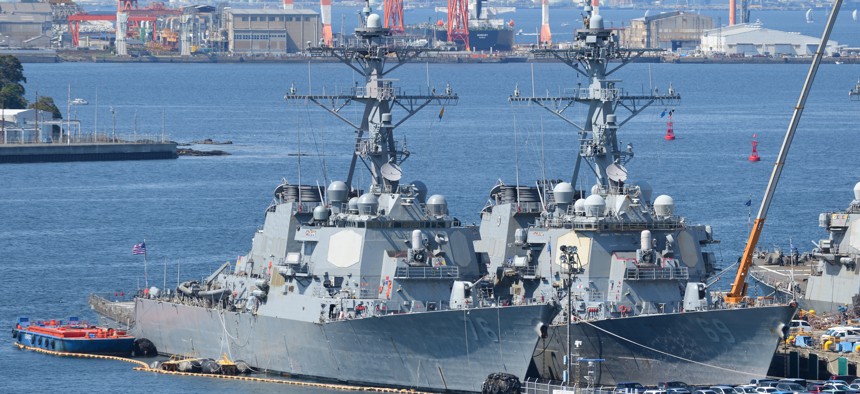
A pair of Arleigh Burke-class destroyers docked in Kanagawa, Japan. Gettyimages.com/ viper-zero

 By
Nick Wakeman
By
Nick Wakeman
The General Services Administration could not evaluate the documentation of a warehouse lease written entirely in Japanese with no English translation.
The Government Accountability Office has released its decision explaining why SupplyCore failed in its bid to hold onto a logistics support contract for U.S. military installations in Japan.
While we reported the decision earlier this month, the public release of the details reveal how a Japanese-language lease agreement and a lower-priced competitor combined to end SupplyCore's five-year run supporting U.S. military installations in Japan.
Amentum won the $77.8 million contract in January to beat out SupplyCore's bid of $81.4 million.
SupplyCore protested the award, arguing GSA unreasonably evaluated its proposal. GAO denied all of the company's challenges in an April 9 decision that was officially released on Wednesday.
The decision shows how close the evaluation was in many areas. Both companies received identical ratings — "Good" — under the technical excellence and capabilities factor, and both were rated "Outstanding" on the live test demonstration.
SupplyCore had a stronger past performance record, which was rated "Very Relevant" versus Amentum's "Relevant."
But the evaluation gap came under the operational quality assurance factor, where Amentum was rated "Outstanding" and SupplyCore received only "Acceptable." Amentum demonstrated two unique strengths in that area while SupplyCore's approach was considered merely adequate, according to the decision.
With the proposals closely rated overall, the source selection authority determined price carried more weight and Amentum's bid was about $3.6 million lower.
The General Services Administration ran the procurement for U.S. Indo-Pacific Command and dinged SupplyCore for its warehouse documentation.
SupplyCore submitted a lease agreement written entirely in Japanese and claimed the solicitation did not require supporting documents to be in English.
But GSA said it could not verify the warehouse address, the length of the lease, or whether the space would be available at contract start without an English translation.
GAO sided with the agency, noting that the entire procurement was conducted in English and the request for proposals gave no indication documents in other languages would be accepted. GSA was entitled to apply that requirement even without stating it explicitly, GAO said.
SupplyCore also argued that GSA failed to assign strengths to its proposal, despite the agency evaluators saying the proposal had “positive merits.” The incumbent argued that this was an inconsistency in the evaluation.
GSA was backed in its finding that SupplyCore's general approach was favorable, but that no individual feature rose to the level of warranting a strength designation.
The contract covers logistics support for more than 100 U.S. installations in Japan and spans at least 300 product categories including office supplies, tools, hardware and cleaning products. The fixed-price contract runs for one year with four one-year options.