
Booz Allen puts more emphasis on products in its new fiscal year
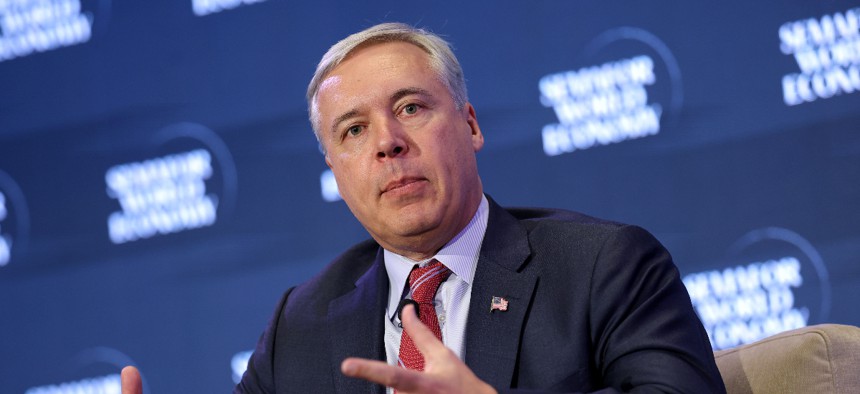
Booz Allen Hamilton CEO Horacio Rozanski speaking at the Semafor World Economy 2026 summit on April 14 in Washington, D.C. Photo by Kevin Dietsch / Getty Images

 By
Ross Wilkers
By
Ross Wilkers
In talking with Wall Street, CEO Horacio Rozanski describes how this leg of the firm's strategy aims to align with the administration's desire for more fixed-price and outcome-based contracts.
Booz Allen Hamilton has directly tied growth in headcount to financial success on its top and bottom lines, but that relationship appears likely to be less direct in future iterations of the company’s strategy. That is especially true when considering the rough waters Booz Allen has traveled over the past 12 months with respect to its civil business and workforce cuts.
During Booz Allen’s fourth quarter and fiscal-year end earnings call Friday, CEO Horacio Rozanski described some of the company’s efforts to evolve its business model in a market still experiencing many changes.
In its fiscal year 2026 financial report, Booz Allen said its headcount stood at 31,500 as of March 31 to show a 12% decline from the prior year.
The Trump administration’s ongoing push to overhaul government procurement, including an executive order calling for more fixed-price contracts, is one factor in a landscape that many in industry appear to be readjusting to.
For Booz Allen, a big piece of its readjustment to a world of more fixed-price and outcome-based contracts involves working toward providing more of its offerings as products.
Rozanski told analysts Booz Allen is fast-tracking efforts to develop Vellox, a portfolio of cyber defense products that pair operators with artificial intelligence agents to counter adversaries that also use agentic AI techniques.
“We took the decision of taking what was going to be a release over the next 18 months, or four different aspects of our Vellox suite, to try and compress it all into the first half of this year because the demand is now,” Rozanski said. “Things that we're not going to be out in the market for another one-and-a-half years are in beta with some customers already.”
Calendar year 2026 is one where offensive cyber tools are becoming more agentic in nature at a faster rate than defensive cyber tools, Rozanski said.
Any conversation about the relationship between cyber and AI also brings up Anthropic’s release of Claude Mythos, a large language model developed to find software vulnerabilities.
Rozanski acknowledged that every conversation with federal and commercial clients “may begin with Mythos, but doesn’t end with Mythos.”
When referring to conversations about Booz Allen and headcount, Rozanski said the company typically increased its workforce “evenly during the year” in every year. But now, Rozanski said the math is “much more complicated given the year we had last year."
In essence, Booz Allen’s idea behind productizing its offerings is meant to align with the administration’s desire to structure more technologies as fixed-price or outcome-based.
“Customers, when they pay for an outcome, give us a lot more flexibility in terms of how we bring technology and structured technology inside a program,” Rozanski said. “That's where you begin to see this divergence.”
How quickly will agencies shift toward these types of contracts and when do they typically do so? Rozanski said procurement teams inside agencies tend to be more willing to discuss a move to fixed-price or outcome-based at the time of awarding an option year, or some other conversion point in the contract.
Many of Booz Allen’s civil contracts that got reduced in scope were fixed-price, Rozanski said, whereas the majority of the company’s national security work is cost-plus.
“Certainly the recent (executive order) and upcoming guidance from OMB (the Office of Management and Budget) is going to push our customers in that direction,” Rozanski said.
Fourth quarter revenue of $2.8 billion was down 6.4% from the prior year period, while profit of $309 million showed a 2.2% year-over-year decrease in adjusted EBITDA (earnings before interest, taxes, depreciation and amortization).
Full fiscal year 2026 revenue of $11.2 billion was also down 6.4% from that of FY 2025, and adjusted EBITDA of $1.2 billion showed a 6.5% decrease. The adjusted EBITDA margin of 11% was flat.
Booz Allen’s initial guidance for its 2027 fiscal year, which started April 1, has revenue in the range of $11.2 billion to $11.7 billion, with an adjusted EBITDA outlook of $1.24 billion-to-$1.29 billion.
NEXT STORY: Airbus' US defense arm promotes Veneziano to CEO