
Doing Business With National Security Agency/Central Security Service

National Security Agency/Central Security Service<br>Fort Meade, Md. 20755<br>301-688-6524<br>
National Security Agency/Central Security ServiceFort Meade, Md. 20755301-688-6524 November 1952. CSS was established in 1972. Air Force Lt. Gen. Michael Hayden, director of the National Security Agency, chief of the Central Security Service; William Black, deputy director, NSA The official U.S. cryptologic organization, NSA coordinates, directs and performs specialized activities to protect the integrity of national communications systems and to seek information about adversaries' secret communications. It is one of the government's most important centers of foreign language analysis and research. It works closely with the Central Security Service to promote partnership between NSA and cryptologic elements of the armed forces. This information is classified. Among its employees are analysts, engineers, physicists, linguists, computer scientists, researchers, security officers and administrative and clerical assistants. NSA says it's the largest employer of mathematicians in the United States, possibly the world. NSA announced in April that it was looking to hire 1,500 employees by September, and wanted to add 1,500 employees each year for the next five years. Information Assurance and Signal Intelligence appear to be more like branches than like subagencies. NSA's budget is classified.XXXSPLITXXX- Chief Information Officer, National Security Agency/Central Security Service March 3 "I grew up in a large family in Oakland, California and enjoyed having lots of people around me." "I'm living in the Northeast now, and I like that I'm still able to take advantage of the richness of having two large cities nearby." "I play music at home on a couple of instruments, and I exercise. I'm also an avid reader." "The 9/11 Commission Report: The Final Report of the National Commission on Terrorist Attacks upon the United States" "An important story that's very well-written." Bachelor of science degree in business administration from California State University at San Jose; master of science degree in the technology of management from American University. Williams retired from the Air Force with the rank of colonel.WT: How has technology changed what your agency does or how it does it?Williams: There's been a quantum leap in the volume, velocity and variety of global communications. NSA needs to respond by ensuring that information, expertise, tools and wisdom can quickly flow where they're needed. We're pursuing new technologies and models for sharing information and knowledge. We're enhancing our IT infrastructure to improve collaboration internally and across the intelligence community.Williams: NSA recognizes and understands the importance of industry alliances to achieve its goals and objectives. NSA continues to broaden collaborative partnerships with industry in purchasing products and services that can help the agency stay on the cutting edge of technology while allowing us to focus our attention on our core missions.Williams: Companies can register to do business with us on the Internet at www.nsa.gov, by going to the Acquisition Resource Center [ARC] in the business section. It's a business registry that provides our industry partners with a one-stop source for acquisition information. Agency personnel and contractors also use the ARC as a market research tool and a way to distribute acquisition documents.Williams: We're pursuing virtual private networks and multisecurity-level technologies to give us more agile network connectivity. We're also moving to an IT infrastructure that's more globally balanced, so we're investing in load leveling and fail-over capability to achieve that equity between remote locations and headquarters.
www.nsa.gov
Founded:
Leadership:
What it does:
Employees:
Major subagencies:
Number crunching: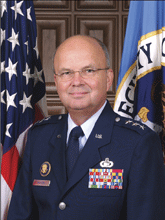 Full title:
Took the job:
Hometown:
Home now:
Hobbies:
Currently reading:
Alma mater:
WT: What do you look for in companies with which you are thinking of doing business?
WT: For a company that is new to working with the your agency and has something to offer you, where is a good place to start? What would you advise them?
WT: A year from now, where do you see the agency's technology capabilities?
www.nsa.gov
Founded:
Leadership:
What it does:
Employees:
Major subagencies:
Number crunching:
La Forrest Williams
Courtesy of NSA
Took the job:
Hometown:
Home now:
Hobbies:
Currently reading:
Alma mater:
WT: What do you look for in companies with which you are thinking of doing business?
WT: For a company that is new to working with the your agency and has something to offer you, where is a good place to start? What would you advise them?
WT: A year from now, where do you see the agency's technology capabilities?
NEXT STORY: Color my world: Printers take on a new hue