
Doing Business With Tennessee Valley Authority

400 W. Summit Hill Drive<br> Knoxville, Tenn. 37902<br>(865) 632-2101<br>
Tennessee Valley Authority400 W. Summit Hill Drive Knoxville, Tenn. 37902(865) 632-2101 May 18, 1933 Glenn McCullough Jr. Skila Harris, Bill Baxter 13,000 The Tennessee Valley Authority is a federal corporation. It is the nation's largest public power company, and its fifth largest electric utility. It provides wholesale power to 158 municipal and cooperative distributors, and directly serves 62 large industries and government installations in the valley; it supplies energy to 8.3 million people. TVA services about 80,000 square miles in the southeastern United States, including almost all of Tennessee and parts of Mississippi, Kentucky, Alabama, Georgia, North Carolina, and Virginia. It manages the nation's fifth-largest river system and protects a 41,000-square-mile watershed. TVA takes an integrated management approach to run its 49 dams on the Tennessee River and its tributaries. Its main offices are in Knoxville, Chattanooga and Nashville, Tenn., and Muscle Shoals, Ala. There are 15 customer-service centers, seven regional economic development offices, 12 watershed team offices, 11 coal-fired plants, six combustion turbine plants, three nuclear plants, 29 hydroelectric dams and a pumped-storage plant. XXXSPLITXXX- Chief information officer June 2000 Chattanooga, Tenn. Same "Just me." "Most any sport: golf, softball, basketball, volleyball and water skiing." "How to Think Like a CEO: The 22 Vital Traits You Need to Be the Person at the Top," by D.A. Benton Bachelor of science in business administration from the University of Tennessee at ChattanoogaBunch: Information technology is a critical business enabler for all of TVA's business functions ? from the typical business applications to the operational aspects of supporting a diverse energy business consisting of three nuclear plants, 11 fossil [fueled] plants and 29 hydro [powered] plants that serve electricity to more than 8.3 million customers across seven states.Bunch: Compared to a typical IT shop, I think the quality assurance rigor that we are required to support for our nuclear applications is unique. Bunch: Several examples come to mind. We have completely automated our supply chain and interfaced it with the work management and asset management used to maintain and operate our plants. This has allowed TVA to reduce inventory, provide material information on a near real-time basis and better plan our work.A second example would be the automation of human-resource functions through our Employee Self Service system, [including] pay, time reporting, benefits, expense reimbursement, etc. Bunch: Just recently, we converted all the revenue contracts from hard copy to electronic format to reside on our electronic document management system. The latest enhancement to that system is the electronic workflow process, which has reduced the time required for our customer service and marketing organization to process tasks related to customer management.Bunch: Quality business solutions, superior support and company viability. Bunch: We are in the process of evaluating and implementing enterprise application integration technology as the underlying technology to support a Power Systems Optimization Project.Bunch: Hopefully more streamlined, standardized and automated as we strive to do more with less.
www.tva.gov
Founded:
Chairman:
Directors:
Employees:
What it does:
Major components: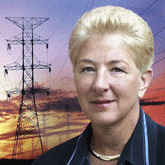 Full title:
Took the job:
Hometown:
Home now:
Family:
Hobbies:
Last book read:
Alma mater:
WT: How does your agency use IT?
WT: Do you have specific needs that may be considered unique?
WT: What technology, if any, has made the agency's mission easier?
WT: How have you transformed your paperwork into electronic files? How is it going?
WT: What do you look for in companies with which you are thinking of doing business?
WT: What are you looking for techwise for the agency's future?
WT: A year from now, where do you see the agency's technology capabilities?
www.tva.gov
Founded:
Chairman:
Directors:
Employees:
What it does:
Major components:
Diana Bunch
TVA
Took the job:
Hometown:
Home now:
Family:
Hobbies:
Last book read:
Alma mater:
WT: How does your agency use IT?
WT: Do you have specific needs that may be considered unique?
WT: What technology, if any, has made the agency's mission easier?
WT: How have you transformed your paperwork into electronic files? How is it going?
WT: What do you look for in companies with which you are thinking of doing business?
WT: What are you looking for techwise for the agency's future?
WT: A year from now, where do you see the agency's technology capabilities?
NEXT STORY: Accessibility opens up